Herbal Spice Crafting

- Description
- Curriculum
- FAQ
- Reviews
- Grade
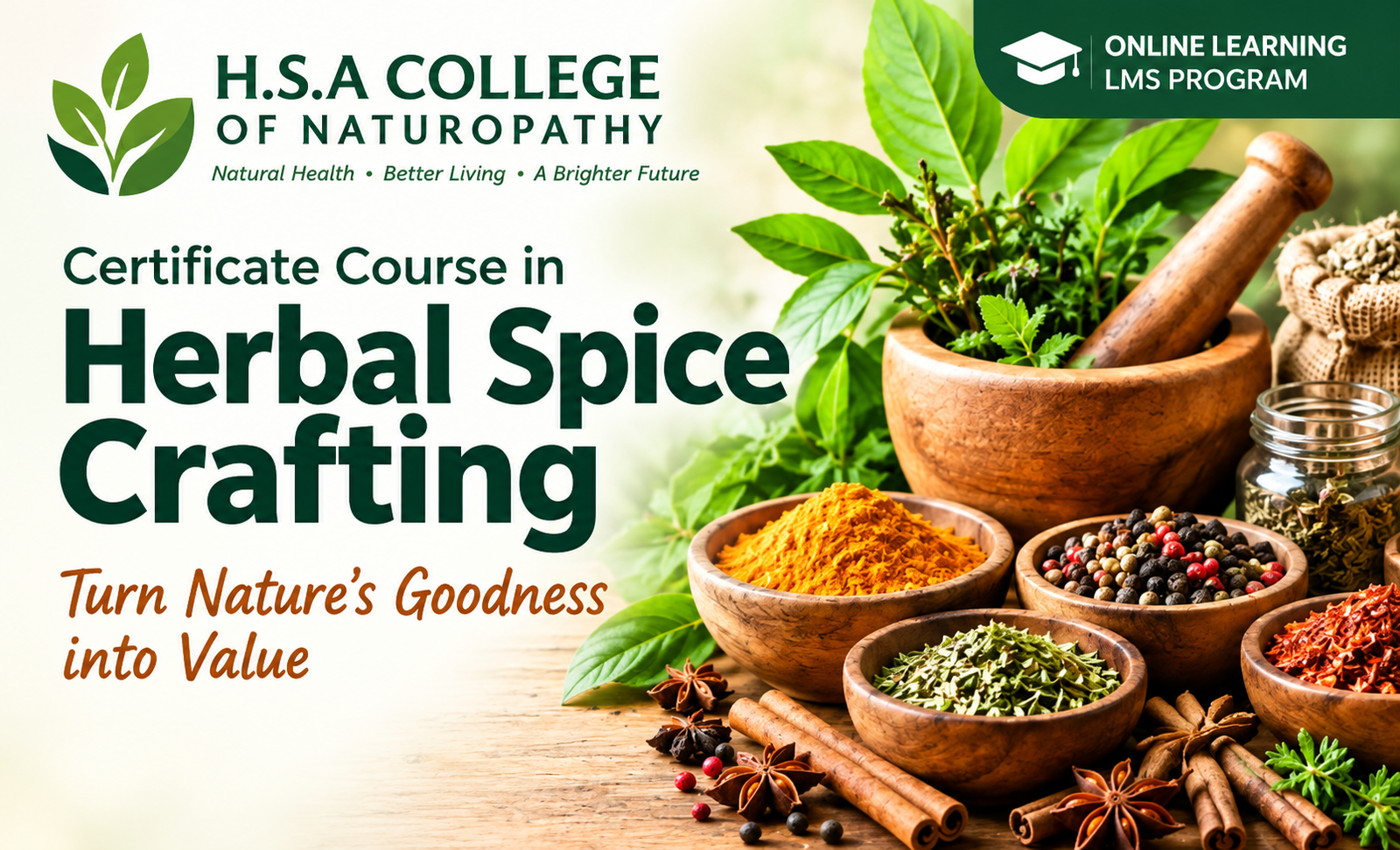
The Professional Certificate in Herbal Spice Crafting is a 12-week competency-based programme designed to equip learners with the knowledge and practical skills required to identify, select, process, formulate, blend, package and appropriately use herbs and spices for culinary and wellness applications.
The programme integrates traditional knowledge of herbs and spices with basic principles of botany, nutrition, phytochemistry, food hygiene, product formulation, quality control and entrepreneurship. Particular attention is given to locally available Ghanaian and West African spices alongside internationally recognized culinary spices.
Students learn through guided theory, demonstrations, practical crafting sessions, independent activities, case studies and product-development assignments. By the end of the programme, each learner should be able to transform selected raw herbs and spices into safe, appropriately formulated and market-ready spice products within the limits of their training.
-
1
 Week 1: Foundations of Herbal Spice Crafting & Plant Botany
Herbal spice crafting is the practical and scientific process of selecting, preparing, processing, combining, packaging, labelling, storing, and using herbs and spices for food and other appropriate applications.
-
2
 Assignment 1
 -
3
Lesson 2: Basic Plant Botany for Spice Crafters
Knowing which plant part you are working with tells you how to harvest it, how it will dry, and where its flavour compounds are concentrated. Roots and barks generally hold flavour in denser, more fibrous tissue and need longer drying times at controlled temperatures;
-
4
 Quiz
Quiz -
5
Lesson 3: Herbs vs. Spices: Definitions and Classification
It is worth noting that some plants blur these categories: dill, for instance, gives both a leafy herb (dill weed) and a seed spice (dill seed), each with a distinct flavour and distinct classification.
-
6
Quiz
-
7
Lesson 4: Overview of the Global and Ghanaian Spice Industry
In Ghana, smallholder farmers, local markets (such as regional produce and spice markets) and small agro-processing businesses form the backbone of the spice value chain. Much of the raw material historically leaves the country, or the local market, in unprocessed or minimally processed form, meaning most of the economic value is captured elsewhere.
-
8
Quiz
-
9
Lesson 5: Course Orientation, Ethics & Scope of Practice
A simple test you can apply throughout your career: if a sentence you are about to write or say could reasonably be understood as "this product will fix a medical problem," rewrite it. Focus instead on sensory language — taste, aroma, culinary use, tradition of use in cooking — which is both compliant and, often, more genuinely persuasive to customers than an unverifiable health claim.
-
10
Quiz
-
11
Week 1 Module Quiz
-
12
Lesson 1: Roots & Rhizomes: Ginger and Turmeric
Ginger (Zingiber officinale) and turmeric (Curcuma longa) are rhizomes — underground horizontal stems, not true roots — widely cultivated in Ghana's forest and transition zones. Fresh ginger has a firm, pale tan skin with visible "finger" segments and a sharp, peppery-citrus aroma when cut, produced by compounds called gingerols. Turmeric rhizome is smaller and more cylindrical, deep orange internally due to the pigment curcumin, and stains hands, clothing and work surfaces on contact — a useful identification clue in itself.
-
13
Quiz
-
14
Lesson 2: Seeds & Pods: Grains of Selim, Alligator Pepper, Negro Pepper
Negro pepper (Xylopia aethiopica) is a slender, elongated, dark brown to black pod with a pungent, slightly bitter, smoky aromatic seed inside. Unlike alligator pepper's rounder pod, negro pepper's pods are notably thin and curved, almost finger-like, which is a useful visual distinguishing feature.
-
15
Quiz
-
16
Lesson 3: Leaves: Local Basil (Nunum), Mint and Bay Varieties
-
17
Quiz
-
18
Lesson 4: Barks & Fruits: Prekese and Cinnamon-Type Barks
Bark and dried-fruit spices are generally more stable in storage than leaves, owing to their lower surface-area-to-mass ratio and tougher outer structure, but should still be checked for insect damage (small holes, powdery residue called frass), mould (fuzzy growth or unusual dark spotting), and correct shape/colour before use, since even stable spices degrade eventually or can be adulterated with inferior material.
-
19
Quiz
-
20
Lesson 5: Field/Practical Identification Exercise
When genuinely uncertain, the professional response is to set the sample aside rather than guess: label it "unconfirmed," seek a second opinion from an experienced colleague or reference material, and never process or sell a spice product you cannot confidently identify, since this risks both product quality and, in the worst case, customer safety if the sample is not actually what it was assumed to be.
-
21
Quiz
-
22
Week 2 Module Quiz
-
23
Unit 1 Warm Spices: Cinnamon, Clove, Nutmeg, Allspice
-
24
Quiz
-
25
Unit 2: Pungent Spices: Black Pepper, Chili, Mustard
-
26
Quiz
-
27
Unit 3: Aromatic Seeds: Cumin, Coriander, Fennel, Cardamom
-
28
Quiz
-
29
Unit 4: Herbs: Thyme, Rosemary, Oregano, Sage
-
30
Quiz
-
31
Unit 5: Comparative Practical: Sensory Evaluation
-
32
Quiz
-
33
Unit 1: Nutritional Composition of Herbs & Spices
-
34
Quiz
-
35
Unit 2: Introduction to Phytochemicals
-
36
Quiz
-
37
Unit 3: General Functional Properties (Non-Clinical Overview)
-
38
Quiz
-
39
Unit 4: Factors Affecting Potency: Storage, Heat, Moisture
-
40
Quiz
-
41
Unit 5: Responsible Communication: Avoiding Unsupported Health Claims
-
42
Quiz

Programme Structure at a Glance
The programme runs over 12 weeks. Each week (module) contains 5 lessons; each lesson closes with one problem-solving assessment, and each week closes with a 10-question multiple-choice module quiz (70% required to pass). In total, the programme contains 60 lessons, 60 problem-solving assessments and 120 quiz questions.
|
Week |
Module Title |
|
1 |
Foundations of Herbal Spice Crafting & Plant Botany |
|
2 |
Identification of Common Ghanaian & West African Herbs and Spices |
|
3 |
International Culinary Spices |
|
4 |
Nutrition & Phytochemistry of Herbs and Spices |
|
5 |
Food Hygiene & Safety in Spice Handling |
|
6 |
Harvesting, Drying & Post-Harvest Processing |
|
7 |
Milling, Grinding & Particle Size Reduction |
|
8 |
Spice Blend Formulation Principles |
|
9 |
Practical Blending Techniques & Recipe Development |
|
10 |
Packaging, Labelling & Shelf-Life |
|
11 |
Quality Control & Regulatory Standards |
|
12 |
Entrepreneurship, Marketing & Capstone Product Development |